
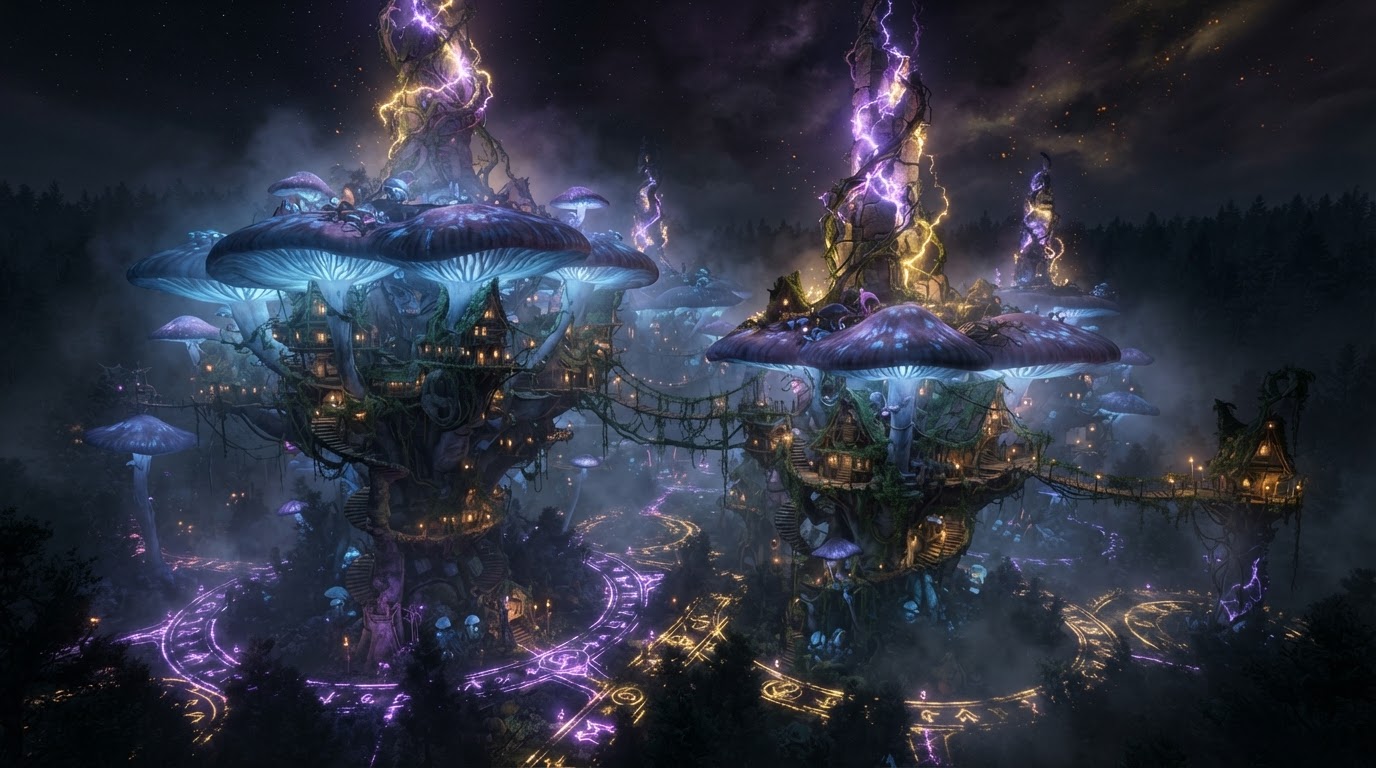
The Alchemy of Defense: Balancing Magic in EOWW
How we adapted lane-defence mechanics into a 360-degree elemental city-building ecosystem — and the mathematics of mana regeneration versus tower degradation.
Lane defence is one of the most elegant systems in games. You have a threat that moves in a predictable direction, a limited budget, and a grid. The genius of the form is that it turns a battle into an act of arithmetic: how much damage can you place per tile before the tile is reached? Everything a player does is legible. Everything a designer does is measurable.
City building is the opposite. It is a sprawling, non-linear negotiation between systems that never resolves. There is no wave counter. There is no win screen. The pleasure is in watching a place slowly become itself.
When we started Elements of Witches & Wizards, we were told repeatedly that these two genres do not belong in the same box. We built the box anyway, and the last two years have been an exercise in figuring out what happens inside it.
Why the lane had to break
Our first prototype was almost embarrassingly faithful to the classics. Five horizontal lanes, waves entering from the right, towers placed left. It worked immediately, which was the problem — it worked so well that the city on the other side of the screen became decorative. Players optimised the lanes and ignored the coven entirely. The village was wallpaper.
So we did the thing you are not supposed to do: we removed the lanes.
What replaced them was a radial threat model. The coven sits at the centre of a hex-tiled valley, and corruption pushes inward from the treeline on any of twelve approach vectors. Each night, only three to five of those vectors activate, telegraphed at dusk by the colour of the mist. This preserved the essential lane-defence contract — you know where the pressure is coming from, and you have time to prepare — while making geography matter. A tower is no longer "in lane three". It is on the north ridge, which is also where your quarry is, which is also why your stonemasons live there.
The moment placement became a civic decision as well as a tactical one, the two halves of the game stopped competing.
Mana as a shared currency, not a resource pool
The single most important balance decision in EOWW is that mana is not produced by towers. It is produced by *people*.
Every inhabited district generates a small trickle of ambient aether based on population, contentment, and the presence of study buildings. Towers draw from that trickle. This means offensive capability is downstream of civic health, and it creates the central tension of the game: the safest thing you can do in the short term — ring your coven in Emberwick Spires — is the thing most likely to starve you in the long term, because spires occupy tiles that could have housed herbalists.
The regeneration curve went through eleven revisions. Linear regeneration made wide cities trivially dominant; you simply built outward until your mana income outpaced any wave. Exponential regeneration made the first twenty minutes agonising and the last twenty meaningless. We landed on a logarithmic curve with a soft cap that lifts only when a Runewright Athenaeum is constructed.
The Athenaeum is the keystone piece. It is expensive, it is not a weapon, and it raises the ceiling for everything in its radius. Players who understand EOWW build Athenaeums early and suffer for it. Players who do not build them find themselves at wave thirty with six beautiful towers and nothing to feed them.
Degradation: the honest clock
Towers in EOWW degrade. Not because we wanted an attrition system, but because a defence game with permanent structures has no second act. Once a build is solved, the remaining waves are a formality.
Degradation is expressed as structural integrity, and it drops in three ways: absorbing damage, firing (elemental strain), and simple weather between chapters. A tower at low integrity does not stop working — it becomes erratic, with wider damage variance and a longer cooldown. We chose variance over failure because outright breakage felt like punishment, whereas unreliability feels like a *material* with a personality.
Repair costs stone and labour, and labour is the same pool that builds your city. So every night that goes badly steals a morning of construction. This is the loop we are proudest of: combat does not merely gate the city builder, it taxes it, and the tax is visible in the streets the next day.
The numbers, roughly: a mid-tier tower loses about 4% integrity per wave it actively participates in, and 1% per chapter transition. Full repair costs 22% of its build price. Rootwarden Bastions are the exception — they regrow, at the cost of a slow loam drain that competes with your farms. Every element has one rule it is allowed to break.
Elemental resonance instead of a rock-paper-scissors chart
The books that EOWW is based on describe magic as *relational*. Fire does not simply beat ice; fire near water produces steam, which conceals, which is sometimes worse than either alone. We wanted mechanics with that texture, which meant refusing a clean counter-matrix.
Adjacency is the mechanism. Two towers of complementary elements placed within two tiles form a resonance, granting a third effect that neither has alone. Tidecaller plus Emberwick yields a scalding fog that blinds ranged corruption. Zephyr plus Rootwarden yields a thorn gale that strips armour. There are currently thirty-one resonances, and roughly a third of them are actively bad ideas — Hollow Beacon resonances are all powerful and all corrosive to district happiness.
This is where balance stops being arithmetic and becomes editing. A resonance chart cannot be tuned to fairness; it can only be curated for interest. Our rule is that no resonance may be strictly optimal in more than two of the game's nine biomes. If it is, we do not nerf its damage — we change where it can exist.
What we learned
Hybridity is not addition. You cannot bolt a city builder onto a defence game and expect a third thing to emerge. The two systems must share a currency, share a clock, and share a map, so that a decision in one is felt in the other within minutes.
For EOWW, the shared currency is mana born of contented people, the shared clock is degradation, and the shared map is a valley where the best tactical ridge is also the best place to live. Everything else — spell tiers, wave composition, biome modifiers — is decoration hung on those three nails.
We will be opening the Closed Arcanum test later this year, and the mana curve will change again. It always does.
Continue reading

 SSU
SSUOxygen as Currency: The Economic Horror of Space Station Underworld
Redefining dungeon management by making the environment the antagonist — and why we chose fragile humans over monsters.
Read feature
 EOWW
EOWWFrom Page to Pixel: Adapting the Elements of Witches & Wizards Books
A conversation with our concept team about visualising Elemental Resonances that the novels describe only through feeling.
Read feature
 SSU
SSUThe Architecture of Enclosure: Level Design in SSU
Creating a sense of scale inside confined modular corridors, and how corridor psychology drives player stress and strategy.
Read feature