
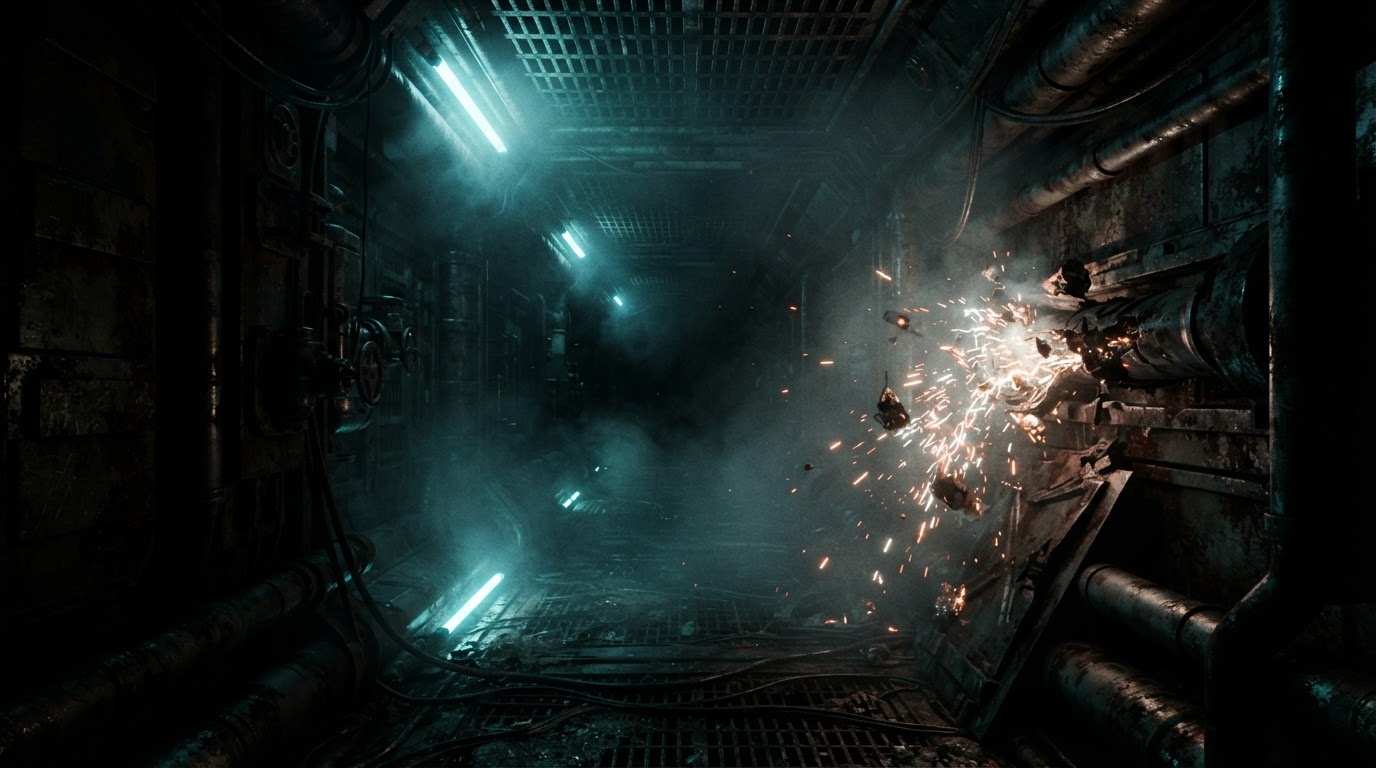
Oxygen as Currency: The Economic Horror of Space Station Underworld
Redefining dungeon management by making the environment the antagonist — and why we chose fragile humans over monsters.
The dungeon management genre has a comfortable premise: you are a villain, your minions are expendable, and the enemy is a hero who eventually walks through your front door. It is a fantasy of ownership. The dungeon is yours, it is solid, and the world outside is a distant nuisance.
Space Station Underworld removes the solidity. Everything you build is a bubble of pressure holding back a vacuum that is patient, silent, and free. The hero at your door is not the threat. The threat is the wall.
Why humans
Early in production we prototyped the obvious version: alien minions with exotic needs. It was fine. It was also weightless, because a creature invented for a mechanic has no life outside that mechanic. When a three-armed gas-breather suffocates, the player's response is "I should have built another vent."
We swapped to humans and the tone of the whole project changed. A human crew member has a name, a bunk, a preference for the mess hall over the corridor, a tolerance for noise, and a body that needs roughly what yours needs. When a human suffocates, the player's response is "I did that."
This is not sentimentality; it is systems design. Human needs are self-documenting. Nobody needs a tutorial to understand that people want air, food, warmth, sleep, and a reason to stay. That legibility freed us to make the *systems* strange instead of the creatures.
The five ledgers
SSU runs on five interlocking ledgers, and only one of them is money.
Pressure. Every tile you excavate adds volume. Volume must be filled, and filled volume must be maintained against micro-leaks proportional to hull surface area. A sprawling station is not merely expensive to build; it is expensive to *contain*, forever. This single rule reframes expansion as a debt rather than a reward, and it is the closest thing SSU has to a thesis.
Oxygen. Reclaimers convert biomass and stored ice into breathable atmosphere at a rate that lags demand by design. You are almost always running a small deficit somewhere, and the game shows it to you as amber shading on the hull map. Learning to run a controlled deficit — sealing the ore wing during a night cycle because nobody works it — is the skill curve.
Heat. Space is not cold in a useful way; it is an insulator. Industry produces heat that must be radiated through fins on the exterior hull, and fins are the most fragile thing you own. Raiders know this. Every player eventually discovers that the industrial heart of their station is hostage to six panels bolted to the outside.
Morale. Crew who are frightened, bored, or hungry begin making choices you did not authorise: skipping a maintenance shift, hoarding rations, or in the worst case opening a bulkhead to make a point. There is no loyalty stat to buy. Morale is produced by the architecture — gravity plating, sightlines, hot food, distance from the reactor's noise.
Reputation. You are an outlaw station. Six factions trade with you, tax you, or raid you, and their attitudes are set by what you do with the people you capture.
Money exists. It is the least interesting ledger, and that is deliberate.
The environment as antagonist
Classic dungeon games escalate by sending bigger heroes. SSU escalates by making your own station heavier.
Each cycle, the station accrues wear: conduits fray, seals harden, coolant lines silt. Wear is not random punishment — it is proportional to the systems you have chosen to run hot. A station that overclocks its reactor to survive a raid will spend the next three cycles patching micro-fractures, and those patches consume the alloy that would have built the turret bay you needed for the next raid.
The result is a difficulty curve authored by the player's own past decisions. Raids are the punctuation; entropy is the sentence.
We nearly lost our nerve on this. Playtesters in the first external round described the mid-game as "relentless", which is a compliment and a warning. Our fix was not to reduce entropy but to make it *predictable*. The diagnostic overlay now projects three cycles ahead: which seals will fail, which section will drop below pressure tolerance, what it will cost to prevent. Dread is fun when it is scheduled. It is exhausting when it is a surprise.
Corridors are the real weapon
In a fantasy dungeon, a corridor is a delivery mechanism for traps. In SSU, a corridor is a liability you have carved into your own budget, and it is also your best defensive tool.
Boarders enter through breach points on the hull, which means your interior layout determines the shape of every fight. A long straight approach gives your gunnery post a firing solution but also gives the boarders momentum. A dog-legged service crawl slows them, but it also slows your damage-control teams, and a fire that reaches the reclaimer ends the run.
Players quickly develop architectural doctrine. Some build a hardened core with sacrificial outer wings that can be depressurised on command — the vacuum does the killing, at the cost of everything stored there. Others build a labyrinth and accept permanent inefficiency in exchange for never fighting on open ground. Both are correct. Neither is safe.
The depressurisation command is the most requested feature we have ever shipped and the one that generates the most horrified messages. It kills boarders. It also kills anyone who did not get the evacuation order in time, and the game does not warn you who that is.
What horror means here
SSU is not a horror game in the jump-scare sense. There is no monster in the dark. The horror is economic: the slow understanding that your station is a machine for converting human hours into breathable air, and that the margin is always thinner than it looks.
The moment we knew the design was working came from a playtest recording. A tester had lost four crew to a hull breach in the ore wing. He did not reload. He sat for a moment, opened the ledger, and said, quietly, "I can't afford to pressurise it again." Then he sealed the wing permanently and kept playing with a smaller station.
That is the game. Not victory over an enemy, but negotiation with a vacuum that never negotiates back.
Continue reading

 EOWW
EOWWThe Alchemy of Defense: Balancing Magic in EOWW
How we adapted lane-defence mechanics into a 360-degree elemental city-building ecosystem — and the mathematics of mana regeneration versus tower degradation.
Read feature
 EOWW
EOWWFrom Page to Pixel: Adapting the Elements of Witches & Wizards Books
A conversation with our concept team about visualising Elemental Resonances that the novels describe only through feeling.
Read feature
 SSU
SSUThe Architecture of Enclosure: Level Design in SSU
Creating a sense of scale inside confined modular corridors, and how corridor psychology drives player stress and strategy.
Read feature